


Crime is evolving with tech, and so is law enforcement. Genetic genealogy, advanced facial recognition, and AI-assisted evidence collection are improving the speed and accuracy of investigative work. But the legal frameworks governing those same tools are still being written.
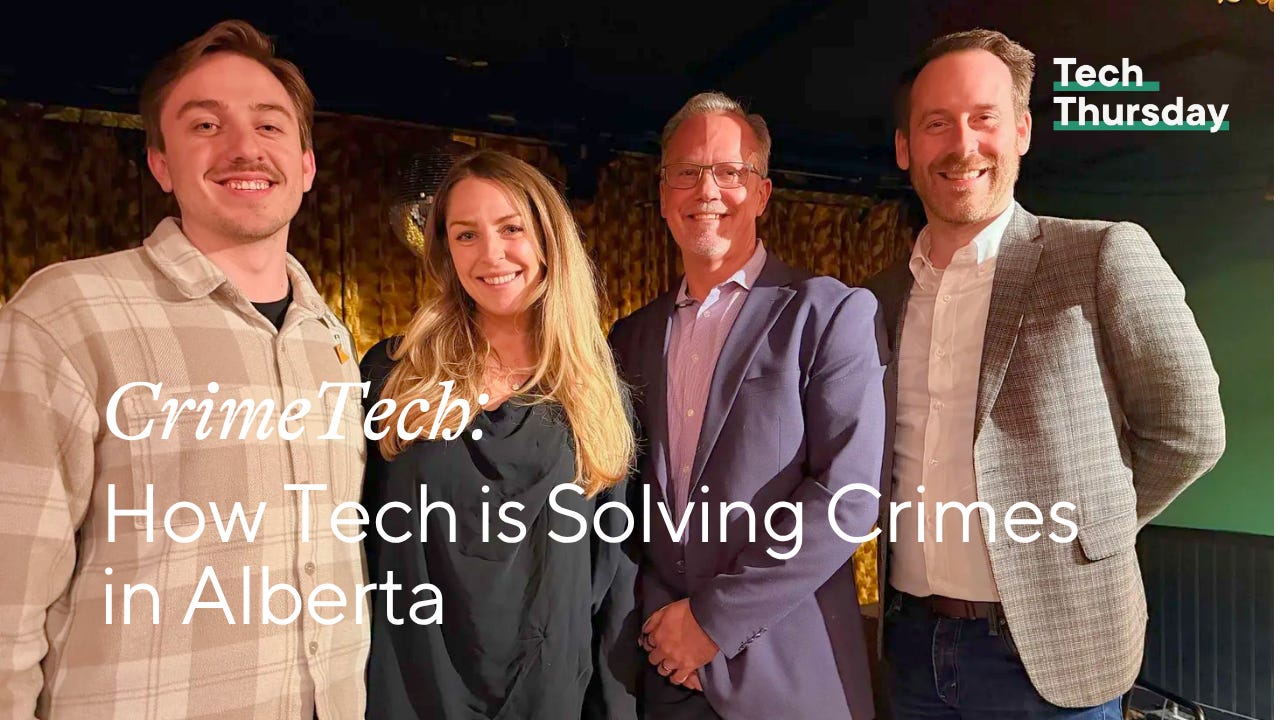
Three people in Edmonton live in that paradox every day, and they all came together at a local bar on March 26th for Tech Thursday. Together, they offer an honest account of what it takes to build, sell and deploy tech in law enforcement today.
Our speakers were:
Bradley Pierson, Founder at Trouvay - A genealogist who solves cold cases with ancestry databases and archival records.
Devin Laforce, Operations Chief at Edmonton Police Service - Overseeing one of the most technologically ambitious law enforcement agencies in Canada
Sam Jenkins, CEO & Co-founder at Standard Field Systems - Digitizing roadside sobriety testing.
Moderated by: Kirsten Sokolovski, Host at Tech Thursday
1. Family Trees and Crime Scenes: The Accidental Detective
Bradley Pierson didn’t set out to build a genetic genealogy company.
At 13, he discovered genealogy. It was an instant obsession. He skipped school to visit archives and dragged his entire family to cemeteries, tracing names, dates, and stories backward through generations. Eventually, he started helping adoptees find their birth parents using consumer DNA testing.
Then he noticed something happening in the United States. Investigators were using the same method to solve violent crimes. Cold cases dormant for decades were suddenly yielding suspects.
The Golden State Killer was identified in 2018, after more than 40 years. His DNA wasn’t in a criminal database, but his distant relative’s DNA was in a consumer one. Investigators built a family tree backward until they found him.
Pierson founded Trouvay to bring that capability to Canada: using consumer DNA databases to identify suspects where no direct DNA match exists.
THIS WEEK at Tech Thursday - Join us on April 30th for a conversation on The Ethics of AI in Marketing, Co-Hosted by Osler.
2. Tech in YEG: First In, All In
Edmonton Police Service’s Operations Chief Devin Laforce oversees one of the most aggressive technology adopters among Canadian police services.
“We’re the first agency in Canada to explore facial recognition through body-worn video application.”
The list of what EPS is running or developing is genuinely long. Facial recognition tied to a mugshot database, rapid DNA testing at the investigative stage, and AI tools being built to draft police reports directly from body-worn camera footage, enabling officers to swap administrative hours for hands-on policing. EPS also runs a dedicated internal data science team, active research partnerships with AI institutes in Germany and the Netherlands, and financial crime modelling designed to map and disrupt money flows in organized crime.
3. Sobering Tools: Redesigning Roadside Evidence Collection
And then there’s Sam Jenkins. CEO and Co-founder of Standard Field Systems, a spin-off from Punchcard Systems. Jenkins came to public safety technology sideways, through work with Edmonton startup Impirica and a Colorado law enforcement task force focused on impaired driving.
He pinpointed a specific problem: the standardized field sobriety test used by virtually every law enforcement agency in North America is a human-driven process administered under often hazardous conditions - dark, snowy, traffic whizzing by.
“There are a lot of factors that are perhaps making it a little bit more challenging for somebody at the roadside. So, in our case, we’re using technology to remove some biases, but also make it a little easier for an officer to focus on the subject.”
Standard Field Systems built a suite of patented tools that digitize and standardize sobriety test data, producing a documented evidentiary record that’s harder to challenge in court.
“Every 40 minutes or so in North America, someone dies in an impaired driving incident. Last year, approximately 1.3 million charges were laid. This problem deserves better evidence than a distracted roadside test can reliably produce.”
4. Facial Recognition is 98.5% Accurate. Still Not Trusted
Trust and bias, believes LaForce, are funny things.
“Under the Canadian Criminal Code, eyewitness testimony is sufficient grounds for arrest. But research shows that eyewitness identification can have an error rate of around 40%. Facial recognition, deployed with proper human oversight, sits at around 98.5% accuracy. And yet we’re still not trusting it,” says LaForce.
The instinct to be suspicious isn’t irrational. The history of surveillance technology deployed without adequate oversight is long and highly contested. But a debate conducted entirely in worst-case scenarios produces paralysis on one side and unchecked adoption on the other.
EPS’s operational framework for facial recognition reflects more precise thinking. The system runs exclusively against a mugshot database. Every officer authorized to make a facial recognition identification has completed training through both the FBI academy and the RCMP. And facial recognition at EPS is never treated as a conclusion — it’s an investigative lead. Corroborating evidence is mandatory before any identification is acted upon.
“Think of it as fast-tracking an investigation,” LaForce says. “Not solving an investigation.”
Jenkins builds the same philosophy into Standard Field Systems: "the tool is not the sworn officer." It's a layer of consistency around a process that was already human-driven, removing variability without removing judgment.
Brought to you by:
Boast - Are you leaving innovation capital on the table? Boast combines AI-powered automation with specialized tax expertise to help tech companies maximize R&D credit returns. Join 2,000+ businesses who’ve secured $675M+ in funding. Get your free assessment at boast.ai

5. Consent, Bias, and Building for the long game
The bias problem Pierson is navigating isn’t algorithmic. It’s about the systemic gap surrounding Indigenous communities, where missing and murdered people go unidentified at disproportionate rates, and where families have waited decades for answers traditional forensic methods couldn’t provide.
“Their data has been used against them time and time again over decades to hurt them,” Pierson explains. “What we’re trying to build is a database where communities actually can consent on a level that allows their community members to choose what they want to opt into.”
This is a more complicated problem than a consent form can solve.
“DNA is not individual data. When you submit your genetic information, you’re also submitting partial information about every biological relative you have.”
The framework Pierson returns to is borrowed from Indigenous ways of knowing: seven-generation thinking. Decisions made today are evaluated against their impact seven generations from now - the opposite of how most technology gets built today.
“We need regulators, people who understand law. We’re trying to listen, learn, and then build something that hopefully can change lives for a long time going forward.”
6. The Leapfrog Problem: Battling Cybercrime, the Third-Largest Economy on Earth
Unsurprisingly, however, regulators and law enforcement are financially constrained. In fact, there’s no dedicated R&D budget at EPS.
“Every dollar that I take right now to explore something is dollars I’m taking away from something that is functioning towards a purpose already,” LaForce says.
Meanwhile, municipal police services are asked to compete with one of the largest concentrations of economic activity on the planet.
“Cybercrime alone is projected to hit $9.5 trillion globally. That would make it the third-largest economy on earth, after the US and China.”
Slowing adoption is the deliberately measured adoption process itself. “These businesses are wildly different from standard SaaS companies. The cycles are longer because we’re talking about something very consequential, and policy change is slower.”
Consequently, Jenkins has earned what he calls “a new form of patience.”
“I watched my daughter grow from a baby into a child during a single sales cycle, which can be 10 to 15 years.”
The slow pace of tech adoption in public safety stands in stark contrast to the rapid pace at which criminals themselves are adopting it.
“It’s like a continuous game of leapfrog. Organized crime jumps first. Law enforcement lands where organized crime was, catches its breath, and starts looking for the next jump.”
Despite constraints, law enforcement is compelled to continue to implement new technology. And it’s already making an impact. By bringing ballistics imaging in-house with IBIS-type technology, EPS has cut processing and turnaround times by roughly 80–90%, compared with the old model of shipping evidence to the RCMP lab.
7. Unstuck
Pierson was driving through Edmonton when he saw a group of people dressed in red walking down the street, carrying a large poster of a woman’s face. He pulled over. The woman holding the poster was Louise Laderoute’s niece. The person next to her was her sister. Louise had been missing for 50 years. Pierson had been digging into the case on his own, and passed a lead to EPS. Six months later, Louise was identified.
“When the case was solved, you could see on their faces what it meant to them after all this time to have their sister back,” Pierson says. “This changes lives. It does not bring the person back, but it can help people get unstuck.”
The question isn’t whether to use the technology, that debate is already settled by the reality of the crimes being committed. The question is whether institutions built to govern powerful tools can evolve fast enough, before the gap between what technology can do and what the system can responsibly absorb erodes the public trust that makes all of it possible.
Nobody has answered that yet. And criminals certainly aren’t waiting around for them to.
👇 Coming up in Edmonton
Thursday, April 30th
Topic - The Ethics of AI in Marketing
Co-Hosted by: Osler
AI is rapidly changing what’s possible in marketing. Companies now have incredibly powerful AI tools at their fingertips, but the conversation about how to use them responsibly is just getting started.
We’re exploring three sides of that conversation: the consumer experience, the builder’s reality, and the legal and ethical frameworks that are still taking shape.
From consumer psychology and behavior, to the real decisions behind building AI-powered products, and the harder questions around bias, accountability, and who’s ultimately responsible when automated decisions go wrong.
Speakers:
Noah Castelo, Associate Professor at University of Alberta
Robert Evans, Principal Product Manager at Wisdom
Adam LaRoche, Partner at Osler
Kirsten Sokolovski, Success Lead at Edmonton Unlimited