


Upcoming Events:
🚀 September 17th
Topic - Fundraising, Culture, Persistence: What Keeps Founders Going
Co-Hosted by: RBCx
Raising money in a difficult market. Building a culture before there’s any proof it works. Staying in it anyway.
James Keirstead, President & CEO at Levven, joins us for a fireside chat on what it’s actually taken to grow a company rewiring how homes get built and lead his team through it.
Levven was acquired in 2011 as a vertical integration play tied to a spa business. It took a few years to realize the real opportunity was in the walls, not the hot tubs. We’ll dig into that pivot, the long stretch of proving the model, the culture it took to hold a team through years without guarantees, and the Series A now closing.
Featuring:
James Keirstead, President & CEO at Levven
Moderated by: Dennis Agbegha, Director, Banking Prairies at RBCx
Tech Thursday is thrilled to welcome Ramp as our new title sponsor!
Ramp launched in Canada this summer and is building a dedicated Canadian team. The company helps businesses save time and money by bringing corporate cards, expense management, bill payments, and accounting automation into one platform. They serve over 70,000 customers globally today.
Ramp’s support will help us bring more ambitious programming, and more leading voices from finance, technology, and operations, to Edmonton’s tech community. We couldn’t be more excited for what’s ahead.

How Generative AI is changing the tune of the music industry
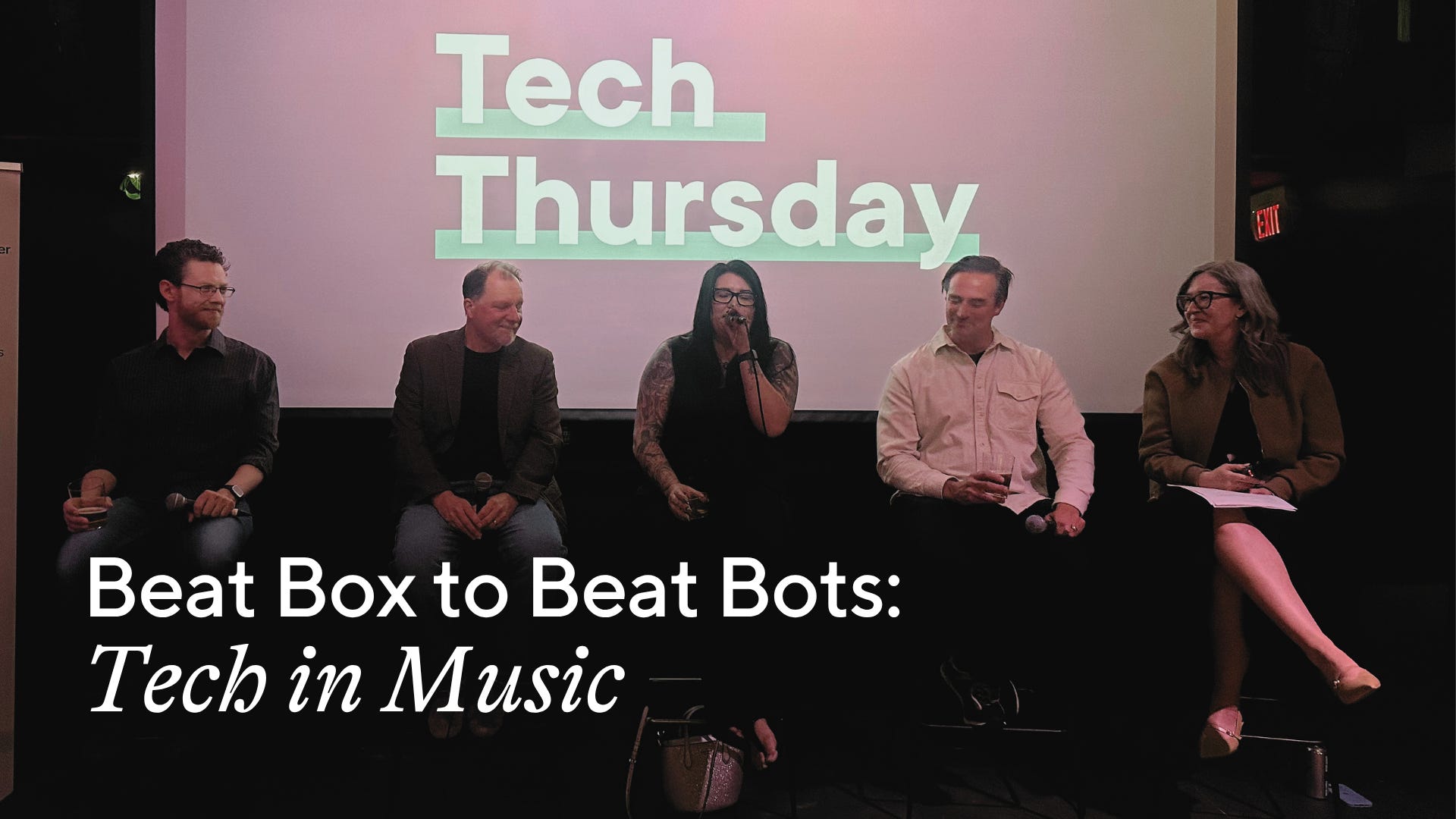
Takeaways from our Tech in Music panel on how generative AI is reshaping the industry, featuring Brian Fauteux (U of A), David Ackerman (DrugBank), Kami Van Halst, and Gordon Gow (U of A), moderated by Madeline Hann (KPMG). Written collaboratively by Mahtab Hoorzad and Kirsten Sokolovski.
In July 2025, The Velvet Sundown’s monthly listenership surged to over 1.4 million. With its hazy, 1970s psychedelic folk-rock feel, it’s easy to see why it caught on so fast. But listeners soon grew suspicious. As CBC’s Kevin Maimann reported, fans began to notice that “the band members had no digital footprint, no record of them ever having performed live, and their album art cover carried hallmarks of generative AI”. Turns out, the band members and music were almost entirely AI-generated.
This revelation raises some uncomfortable questions. How is the music industry shifting with AI? And if a song moves us, does it matter who, or what, created it? These were the topics covered at YEG’s Tech Thursday on June 18th, which brought together musicians, researchers, and tech experts to discuss the opportunities and challenges of new AI music-generation tools and platforms like Suno.
1. “I threw something at it that I thought it couldn’t handle”
With over 2 million paid subscribers, Suno is the world’s leading AI music-generation platform. Throw it a single prompt, and it’ll write you lyrics, compose the vocals and instruments, and toss you back a pitch-perfect pop song. But this ease of creation is precisely what makes it unsettling; the more sophisticated these tools get, the harder they force us to reconsider not only how music is made but also what we value about art, authorship, and human creativity.
Interestingly, though, all three panelists use Suno differently. University of Alberta Media and Communications Professor, Gordon Gow, uses it as a high-end producer to polish his raw music and lyrics. After playing us his original demo alongside Suno’s finished version, he admitted: “I could never do that performance.”
Musician and DrugBank Staff Developer, David Ackerman, treats it more like an experimental tool, feeding it a hard rock track and transforming it into a swingy lounge version to see how the song might work in a different musical context. “I feel a little threatened... this thing is doing some things far better than I could ever hope to do.”
Kami Van Halst, musician and M.A. Candidate researching AI Policy in Creative Industries, uses Suno out of necessity rather than preference. “I don’t play an instrument. My band is in Toronto. I use it to demo, and then we play the performance live together in the studio,” she says.
2. “I think Suno is going to be really disruptive”
The influence of AI on the music industry doesn’t stop at the creative process; it’s also driving a significant economic shift in the industry. AI makes producing music accessible and cheaper, but that same accessibility poses a direct threat to independent studios, engineers, and producers.
“What used to cost you thousands of dollars is now going to cost you virtually nothing to produce.” - Gordon Gow, University of Alberta.
This isn’t the first time artists have felt exploited by a new technology. The music industry is still grappling with the unresolved effects of the turn to streaming, which fundamentally changed how music is monetized. By moving away from album sales, streaming widened the gap between top-tier superstars and everyday independent musicians. For many artists, AI feels like a continuation of that same distancing between the creator and their ability to make a sustainable living. “It’s a very hard time to be a working musician,” says Brian Fauteux, Associate Professor of Popular Music and Media Studies at the University of Alberta.
“Suno’s allowing us to have the equivalent of hiring thousands-of-dollars-an-hour producers. And we can do it all in our homes.” - David Ackerman, DrugBank.
It’s no surprise then, that 82% of musicians don’t want AI generating full songs from scratch, and a similar percentage are worried about AI music’s impact on their income and competition.
3. “I had no idea 40 of my songs were used to train Suno”
AI’s rapid rise in music has also exposed significant legal and policy fault lines. Some major labels, like Sony, are suing AI platforms like Suno for using unlicensed music in their training data. Others, like Warner and Universal, have signed deals with them instead. Artists, meanwhile, largely agree on one thing: It shouldn’t be the label’s call whether the music gets used to train an AI model.
Thanks to The Atlantic’s ongoing investigation into AI training data, published through its AI WATCHDOG project, musicians are discovering their catalogues have been used to train AI models without their knowledge or consent. Many are fighting back. The American Federation of Musicians has already filed a lawsuit against major labels that struck deals with AI companies, arguing that AI use constitutes a “new use” of recordings for which session players were never compensated.
“We’ve got the label suing Suno, we’ve got the American Federation of Musicians suing the labels... I think the people making the most money are probably the lawyers, as usual.” - Prof. Gordon Gow, University of Alberta
4. “What endures is the human aspect of it”
Two things became clear by the end of the night.
One: People care who (or what) made the music. Once The Velvet Sundown reveal broke, the band’s monthly listenership cratered to around 100,000. You might not think twice about an AI-generated track filling out a commute playlist, but you’re probably not walking down the aisle to one, and you’re also not likely to line up for a concert headlined by an algorithm. That’s because knowing the “who” behind a song still changes how we feel about it.
Two: AI hasn’t replaced human creativity — it’s just moved where it shows up. Gordon uses Suno to polish. David uses it to experiment. Kami uses it to prototype. In every case, the human still made the creative call; the tool just executed it. Suno can generate a song in seconds, but it can’t decide what’s worth saying.
“I have faith in humans and being creative. Yes, we’re going to have a lot of AI infusion, but I guarantee you, people are going to put human creativity on top of that. I think people will find ways to bring humanity back into it.” - David Ackerman, DrugBank.
In short, the tools will keep changing. What we choose to make with them, and why, is still very much a human decision.
A big thank you to all of our sponsors for making these events a possibility including Ramp, Boast, Skip, Alberta Innovates, and Crestview Strategy.
